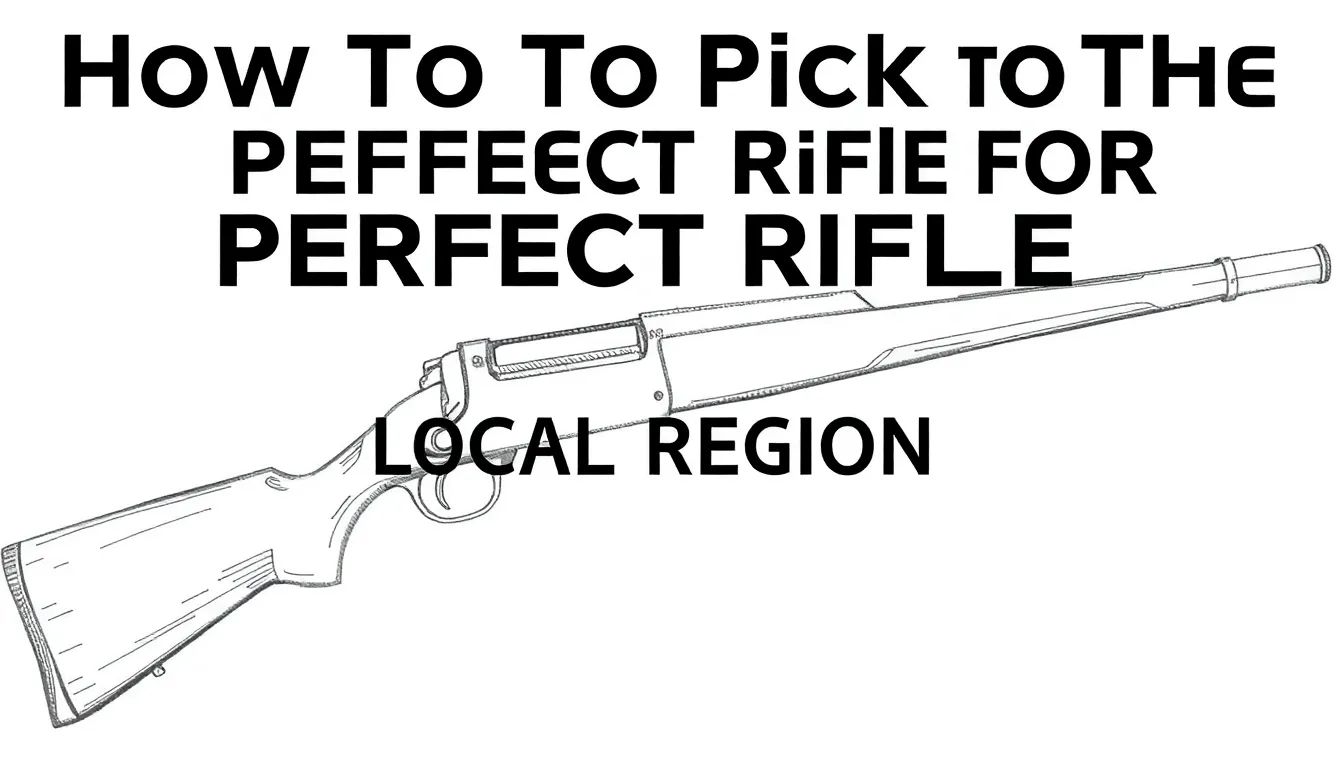
How to Pick the Perfect Rifle for Your Local Region
Understanding Regional Rifle Selection: Concept and Target Audience
Selecting the ideal firearm is rarely a one-size-fits-all endeavor. The regional rifle selection methodology is a strategic framework designed for hunters, homesteaders, and off-grid survivalists who need to match their firearm’s ballistics to their local geography. The core problem it solves is the performance mismatch that occurs when a rifle optimized for one environment is forced into another—such as deploying a short-range brush gun on the wide-open, wind-swept plains of Kansas, or using a heavy, long-range precision setup in the dense undergrowth of the Appalachian mountains. By analyzing foliage density, average target distance, local humidity, and regional hunting regulations, this framework prevents costly and potentially dangerous gear mismatches. Before diving into complex centerfire ballistics, many shooters begin their journey with a classic training rifle to master fundamental marksmanship and safe handling. However, once you transition to regional survival or active hunting, your primary firearm must be tailored to your specific ecosystem. Whether you are protecting property from close-range pests or harvesting large game at a distance, defining your precise regional mission is the critical first step to choosing the correct tool for the job.
Key Environmental Specs and Performance Benchmarks
This selection methodology categorizes terrain into distinct ballistic profiles to optimize bullet performance. In the Northeastern and Western woodlands, shooters deal with dense canopy and thick brush where line-of-sight rarely exceeds 50 yards. Here, heavy, slow-moving projectiles or 12-gauge slug shotguns are favored because they resist deflection from light foliage, whereas a light, high-velocity bullet might deflect off a single blade of grass. Conversely, the Midwestern plains require mid-to-long-range capabilities, where a .308 Winchester or .270 Winchester provides a flat trajectory up to 200 yards in the brush, or beyond 600 yards in cleared fields. For the extreme distances of the Southwestern desert, where visibility can span 30 miles and crosswinds are brutal, the methodology demands high-performance cartridges with low ballistic coefficients capable of clean, ethical harvests at immense ranges. Furthermore, legal compliance is a vital technical specification. Many states restrict semi-automatic actions or impose strict magazine round capacities, making traditional bolt-action or lever-action platforms the legal and practical choice for specific regions.
Drawbacks, Alternative Comparisons, and Buyer Recommendations
While specializing your rifle to a specific region maximizes local performance, it has notable drawbacks. The primary disadvantage is lack of versatility; a highly specialized Southwestern desert rifle chambered in a magnum caliber is far too heavy and destructive for close-range woodland hunting. Additionally, purchasing multiple regional firearms can be financially prohibitive for the average shooter. For those seeking alternatives, modular multi-caliber rifle systems offer a compromise, allowing shooters to swap barrels and bolt heads to adapt to different environments. However, for true beginners or those on a strict budget, mastering basic marksmanship on a low-cost, low-utility tool like a pump air rifle is a highly recommended preliminary step to build muscle memory without burning expensive centerfire ammunition. For the practical buyer, the final recommendation is clear: audit your immediate 100-mile radius. If your landscape is heavily forested, prioritize a fast-handling lever gun or shotgun. If you live in the open plains, invest in a quality bolt-action chambered in .308. Never purchase a rifle based on theoretical scenarios; buy for the reality of the ground beneath your feet.
Source: 5 Keys To Picking The Perfect Rifle For Your Region – Off The Grid News
We are a participant in the Amazon Services LLC Associates Program, an affiliate advertising program designed to provide a means for sites to earn advertising fees by advertising and linking to Amazon.com. As an Amazon Associate I earn from qualifying purchases. We also participate in other affiliate programs.