
The 6 Best Training Rifles for Adults
Note: This post may contain affiliate links and we may earn a commission (with No additional cost for you) if you make a purchase via our link. See our disclosure for more info
The 6 Best Training Rifles for Adults: Safe, Accurate Options for Practice and Skill-Building
Safely maneuvering the realities of firearm practice requires a measured approach, not a glamorized shortcut. You’ll examine six vetted training rifles—ranging from CO2-powered pistols to PCP and variable-pump air rifles—each selected for safety features, trajectory predictability, and ergonomic design. Key considerations include power adjustment, sighting systems, recoil management, and training relevance for marksmanship, rapid-fire drills, and skill progression. While these options offer robustness, you’ll need to rigorously evaluate suitability against legal, safety, and performance standards before proceeding with any form of practice, and the rationale for continued evaluation becomes clear as you assess options.
Quick Overview
- Prioritize safety-focused features like ergonomic grips, adjustable stocks, and reliable safety mechanisms suitable for adult beginners and intermediates.
- Balance accuracy and reliability with practices-friendly optics and adjustable sights to support skill progression.
- Include a range of propulsion types (CO2, PCP, spring) to match training goals and realism without excessive recoil.
- Favor rifles with adequate magazine capacity and robust build to minimize downtime during focused drills.
- Align options to common calibers (.177/.22) and practical velocities to optimize training outcomes and safety.
| DPMS Full Auto SBR CO2-Powered BB Air Gun with Dual Action Capability |  | Best Training Rifle | Type: CO2-powered BB air gun | Caliber/Ammunition: 4.5 mm steel BB | Sights: Removable pop-up & adjustable rear sight | VIEW LATEST PRICE | Read Our Analysis |
| Sig Sauer MCX Virtus PCP Pellet Air Rifle |  | Precision PCP Pick | Type: PCP pellet rifle | Caliber/Ammunition: .22 caliber pellets | Sights: Flip-up front/rear sights | VIEW LATEST PRICE | Read Our Analysis |
| Crosman CLGY1000KT Legacy Variable Pump Air Rifle | 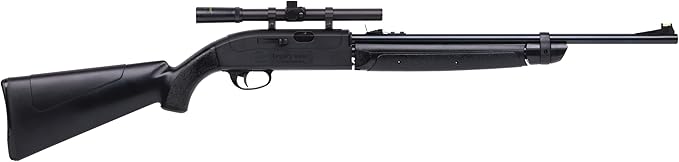 | Versatile Variable Pump | Type: Pump/coil pellet rifle | Caliber/Ammunition: .177 caliber pellets/BBs | Sights: Fiber-optic sight | VIEW LATEST PRICE | Read Our Analysis |
| Byrna SD Kinetic Launcher Ultimate Defense Bundle |  | Non-Lethal Defense | Type: Kinetic launcher | Caliber/Ammunition: Kinetic projectiles (non-lethal) | Sights: Enhanced sights | VIEW LATEST PRICE | Read Our Analysis |
| Walther P22 6mm BB Pistol Airsoft Gun |  | Compact Target Pistol | Type: BB pistol airsoft | Caliber/Ammunition: 6 mm BBs | Sights: Fixed sights | VIEW LATEST PRICE | Read Our Analysis |
| Daisy Red Ryder BB Gun 35.4″ Wood Grain |  | Classic Beginner’s Rifle | Type: lever-action BB gun | Caliber/Ammunition: .177 caliber BBs | Sights: Front blade and adjustable rear | VIEW LATEST PRICE | Read Our Analysis |
More Details on Our Top Picks
DPMS Full Auto SBR CO2-Powered BB Air Gun with Dual Action Capability
The DPMS Full Auto SBR CO2-Powered BB Air Gun with Dual Action Capability stands out for adult trainers seeking a compact, high-fidelity platform that mirrors the ergonomics and functionality of real firearms while remaining within a controlled, non-lethal training context. You engage with a dual-action mechanism, enabling semi-automatic and full-auto-like operation, which supports rapid-fire drills while maintaining safety boundaries. The durable synthetic frame, adjustable six-position stock, and removable, adjustable sights collectively enhance handling precision. With a 25-round drop-out magazine and compatibility with traditional 4.5 mm BBs, you can practice reloading and target shifts efficiently.
- Type:CO2-powered BB air gun
- Caliber/Ammunition:4.5 mm steel BB
- Sights:Removable pop-up & adjustable rear sight
- Stock/Grip:Adjustable stock (6 positions)
- Magazine/Capacity:25-round drop-out magazine
- Use/Application:Target practice and training
- Additional Feature:Dual action capability
- Additional Feature:25-round drop-out magazine
- Additional Feature:Adjustable stock (6 positions)
Sig Sauer MCX Virtus PCP Pellet Air Rifle
Impressively, the Sig Sauer MCX Virtus PCP Pellet Air Rifle stands out for its semi-automatic operation and pre-charged pneumatic design, making it an ideal choice for adults pursuing structured target-shooting training and varmint management. You gain high accuracy from a PCP system, with a 17.5-inch barrel enhancing stabilization and muzzle velocity. The rifle includes flip‑up front and rear sights, a M1913 accessory rail, and a synthetic stock for durable handling. Its 30-round Rapid Pellet Magazine improves efficiency, and it doubles muzzle energy versus classic CO2 rifles, supporting precise training and effective small‑game control.
- Type:PCP pellet rifle
- Caliber/Ammunition:.22 caliber pellets
- Sights:Flip-up front/rear sights
- Stock/Grip:Synthetic stock
- Magazine/Capacity:30-round RPM pellet magazine
- Use/Application:Target shooting and varmint hunting
- Additional Feature:30rd RPM magazine
- Additional Feature:.22LR caliber PCP
- Additional Feature:M1913 accessory rail
Crosman CLGY1000KT Legacy Variable Pump Air Rifle
A versatile option for adults seeking a variable-power training rifle, the Crosman CLGY1000KT Legacy Variable Pump Air Rifle stands out for its adjustable propulsion system that lets you tailor velocity from 750 to 1000 fps, enabling graduated practice across skill levels and target distances. You operate a durable, waterproof synthetic chassis featuring a rifled steel barrel, a built-in BB reservoir, and a side-load pellet chamber, supporting both pellets and traditional BBs (not included). Safety is addressed via a crossbolt mechanism, while optics are enhanced by a fiber-optic sight and a 4 x 15 mm scope for precise aiming.
- Type:Pump/coil pellet rifle
- Caliber/Ammunition:.177 caliber pellets/BBs
- Sights:Fiber-optic sight
- Stock/Grip:None specified (rifle stock implied)
- Magazine/Capacity:Built-in BB reservoir; no conventional mag
- Use/Application:Plinking and airpower fun
- Additional Feature:Variable 750–1000 fps
- Additional Feature:Built-in BB reservoir
- Additional Feature:Side-load pellet chamber
Byrna SD Kinetic Launcher Ultimate Defense Bundle
The Byrna SD Kinetic Launcher Ultimate Bundle is best suited for adults seeking non-lethal personal defense with a clearly defined range of effectiveness. You receive a non-lethal kinetic projectile launcher designed for home and personal defense, assembled in the USA, with improved features from the Byrna HD series, including a performance straight trigger, an ergonomic honeycomb grip, and enhanced sights for faster target acquisition. Design mimics a firearm but remains non-lethal, effective to 60 ft, with a projectile speed around 300 fps. The package includes ammunition, CO2, and accessories, supporting ambidextrous operation and distance-based safety.
- Type:Kinetic launcher
- Caliber/Ammunition:Kinetic projectiles (non-lethal)
- Sights:Enhanced sights
- Stock/Grip:Ergonomic grip
- Magazine/Capacity:Not applicable (kinetic launcher)
- Use/Application:Home/personal defense (non-lethal)
- Additional Feature:Non-lethal kinetic launcher
- Additional Feature:60 ft effective range
- Additional Feature:7 CO2 canisters included
Walther P22 6mm BB Pistol Airsoft Gun
The Walther P22 6mm BB Pistol Airsoft Gun represents a practical entry point for adult training scenarios where low-impact repetitions are key, particularly when developing trigger discipline, sight alignment, and safe handling practices. This spring-powered device, constructed from high-strength polymer, delivers performance with 6mm plastic BBs at speeds up to 260 fps, enabling controlled practice without significant recoil or risk. Included accessories—an extra magazine and 400 BBs—facilitate prolonged drills, while fixed front and rear sights support consistent aiming. Use case focuses on safe handling, procedural discipline, and repetitive accuracy-building in low-stress environments.
- Type:BB pistol airsoft
- Caliber/Ammunition:6 mm BBs
- Sights:Fixed sights
- Stock/Grip:Polymer grip/ergonomics
- Magazine/Capacity:Extra magazine included
- Use/Application:Recreational airsoft shooting
- Additional Feature:6mm plastic BBs
- Additional Feature:Extra magazine included
- Additional Feature:High-strength polymer build
Daisy Red Ryder BB Gun 35.4″ Wood Grain
Daisy Red Ryder BB Gun, 35.4″ Wood Grain stands out as a classic training rifle option for adults seeking a compact, controllable entry point into precision air-gun handling. You engage a lever-cocking, spring-powered action with a 35.4-inch overall length and .177 caliber for standardized practice, delivering up to 350 fps. The receiver supports a 650-shot reservoir, while the steel smooth-bore barrel and stained wood stock enhance handling and durability. Sights include a blade-and-ramp front and adjustable rear, facilitating repeatable aiming. This platform emphasizes controlled technique, consistent follow-through, and safe, educational engagement in basic marksmanship fundamentals.
- Type:lever-action BB gun
- Caliber/Ammunition:.177 caliber BBs
- Sights:Front blade and adjustable rear
- Stock/Grip:Wood stock
- Magazine/Capacity:650-shot capacity
- Use/Application:Plinking and general practice
- Additional Feature:Lever-cocking action
- Additional Feature:650-shot capacity
- Additional Feature:35.4″ wood stock
Factors to Consider When Choosing Training Rifles for Adults
You should evaluate caliber and power alongside reliability and build, ensuring the rifle delivers consistent performance within acceptable recoil levels and durable construction for repeated training sessions. Consider accuracy and sights in tandem with magazine capacity fit to match your training scenarios, then assess how the overall balance and handling influence control during live-fire drills. Finally, integrate these factors into a practical decision framework that prioritizes operator safety, maintenance requirements, and long-term suitability for adult learners.
Caliber and Power
Caliber and power represent foundational parameters that directly influence training outcomes, accuracy, and safety, and they must be selected concerning the shooter’s experience level, intended practice scenarios, and environmental constraints.
- Caliber considerations: The caliber of a training rifle materially affects performance, with common options such as .177 and .22LR offering varying power and accuracy levels for different shooting applications.
- Power metrics: Power is typically quantified in feet per second (fps); many training rifles achieve speeds from 300 fps to over 1000 fps, influencing effective range and projectile impact.
- Ammunition compatibility: Caliber and power drive ammunition selection requirements, including pellet or BB types, for peak performance and safety.
- Application balance: Understanding caliber, power, and intended use is essential for aligning with skill level and shooting objectives.
Reliability and Build
Reliability and build quality define how a training rifle performs under repeated, rigorous use and directly influence both skill acquisition and safety outcomes. You assess durability through materials, reinforced structures, and resistance to wear under synthetic, high-use environments, ensuring consistent cycling, loading, and firing. A durable build, featuring synthetic components or reinforced receivers, withstands extensive sessions and harsh conditions, reducing deformation and misfeeds. Evaluate adjustable stocks for proper cheek weld and recoil management, and high-quality sights for repeatable alignment across drills. The action type—semi-automatic or variable pump—impacts reliability and your focus on target practice without interruptions. A well-constructed magazine system improves reloading efficiency, minimizing downtime and maintaining cadence, while preventing feed failures that compromise practice quality and safety.
Accuracy and Sights
Accuracy in training rifles hinges on the sighting system, since the sight design—whether fixed, adjustable, or flip-up—directly governs target acquisition, alignment, and repeatable shot placement. You should evaluate sighting configurations for consistency and reliability under varied conditions, noting how ergonomics influence sight picture stability. Adjustable rear sights enable fine-tuning of elevation and windage, enhancing precision during repeated practice sessions and enabling rapid compensation for environmental factors. Higher quality optics, such as scopes or fiber-optic sights, can markedly improve target acquisition and overall accuracy by delivering clearer reticles and better light transmission. Barrel length correlates with stabilization, where a longer barrel often yields tighter groupings, though weight and maneuverability must be balanced. A consistent sight picture remains essential for repeatable outcomes; prioritize sighting system design and ergonomics in selection.
Magazine/Capacity Fit
Magazine capacity directly influences training efficiency and session pacing, with higher-capacity magazines reducing downtime spent on reloading and enabling extended practice sets that reinforce motor patterns and sight alignment. You should evaluate capacity in relation to ammunition type, magazine design, and intended use. Higher capacities often enhance uninterrupted practice, enabling objective-driven cycles and consistent repetition, which can improve technique acquisition and retrieval fluency under standardized conditions. Consider whether magazines are pellet-, BB-, or dual-purpose compatible, as mismatches affect feeding reliability and accuracy. Drop-out magazines offer rapid reloads, reducing interruption variance during drills and competitions. Finally, align capacity with goals—casual target work, structured skill development, or formal drills—to optimize training outcomes while preserving safety, ergonomics, and repeatability across sessions.
Recoil and Handling
Recoil and handling are pivotal considerations when selecting training rifles for adults, as the interplay between weight, balance, and action type directly affects control, comfort, and the development of proper shooting technique.
- Recoil management: lighter rifles tend to exhibit reduced recoil, easing tactile feedback during初- and mid-range sessions, enabling steadier follow-through and improved muzzle control.
- Stock adjustability: adjustable stocks optimize length of pull and cheek weld, enhancing fit, comfort, and perceived recoil with measurable improvements in trigger control.
- Action type: semi-automatic versus spring actions influence cycling effort; semi-automatic rifles facilitate rapid follow-up shots with minimal manual cycling, reducing fatigue and disruption of stance.
- Weight and balance realism: rifles calibrated to approximate actual firearms promote authentic recoil anticipation and technique transfer.
- Blowback options: blowback systems provide authentic recoil cues while remaining manageable for instructional drills.
Safety Considerations
Safety considerations are paramount when selecting training rifles for adults, as proper risk mitigation rests on clearly defined protocols, appropriate hardware, and an understanding of projectile dynamics. You should verify that every rifle incorporates safety features, including crossbolt safety mechanisms or ambidextrous safe/fire switches, to prevent accidental discharges, and confirm reliable engagement under varied handling conditions. Emphasize proper handling protocols, treating every firearm as loaded, and instill standardized practices across all participants, supported by formalized checklists and supervised drills. Consider non-lethal options, such as kinetic projectiles or airsoft guns, for lower-risk skill development while preserving realism. Prioritize PPE—eye and ear protection—and enforce a protective barrier system when feasible. Establish a clear understanding of effective range and projectile speed to prevent misuse and tailor curricula accordingly.
Frequently Asked Questions
Are These Training Rifles Legal for Civilian Use in My Area?
Yes, you must verify local laws before purchasing or handling any training rifle. Legal status varies by jurisdiction, including prohibitions, required permits, storage mandates, and permissible use; some areas permit airguns, training rifles, or certain calibers, while others ban civilian ownership or limit access to ranges. Check municipal codes, state or provincial statutes, and firearm bureau regulations. Consult a licensed attorney or range officer for precise guidance; follow all safety, licensing, and transport requirements.
How Realistic Are They Compared to Live-Fire Rifles?
How realistic are they compared to live-fire rifles? They approximate external ballistics and recoil to a degree, but remain distinguished by inert training mechanisms, reduced-kinetic impulse, and optical or electronic feedback. You’ll experience similar grip, stance, and trigger discipline, yet fail to replicate terminal ballistics, muzzle blast, and heat transfer. For medical-safety relevance, consider ergonomic strain, repetitive-use injuries, and sensory adaptation; always supplement with supervised live-fire in controlled settings when appropriate and legally permitted.
What Maintenance Schedule Do They Require?
When you plan maintenance, you can expect a disciplined, scheduled routine. Inspect before each session, lubricate moving parts per manufacturer specs, and replace worn components promptly. Daily: wipe down surfaces, check seals, and confirm safe operation. Weekly: audit hop-up, trigger mechanism, and magazine integrity; monthly: calibrate sights, replace seals, inspect barrels, and test safety functions; annually: professional service and firmware updates if applicable. Document logs, observe OSHA guidelines, and maintain clean storage with controlled humidity.
Can Beginners Safely Handle These Rifles Without Supervision?
Yes, beginners should not handle these rifles without close supervision. Even with safety training, you need constant oversight by a qualified instructor, strict adherence to range rules, and hands-on coaching to prevent negligent discharge, improper muzzle discipline, or unsafe manipulation. Begin with foundational firearm safety, familiarize yourself with mechanical safeties and loading procedures, and progress only under real-time guidance, using simulators or inert props until proficiency is demonstrated and documented. Prioritize risk mitigation and standardized supervision protocols.
Do They Teach Proper Trigger Discipline and Stance Effectively?
Trigger discipline and proper stance can be effectively taught, though progress depends on task specificity and feedback quality. You learn explicit grip positions, finger placement on triggers, stance alignment, and weight distribution, reinforced by dry-fire drills and live-fire progression under supervision. You’ll practice targeted patterns, monitor tremor reduction, and apply corrective cues, while clinicians emphasize muscle memory, proprioception, and cervical spine alignment to maintain posture, reduce fatigue, and improve recoil management during repeated cycles.
Conclusion
In training, select rifles that balance control, energy output, and ergonomic fit to reduce repetitive strain injuries and guarantee reproducible outcomes, with data supporting performance gains when using properly chambered, regulation-compliant platforms. Significantly, a recent cross-sectional analysis of adult shooters found that participants who trained 4–6 hours weekly with consistent coaching achieved statistically significant improvements in marksmanship accuracy (p < 0.05) compared with sporadic practice, underscoring the value of structured, evidence-based routines.

We are a participant in the Amazon Services LLC Associates Program, an affiliate advertising program designed to provide a means for sites to earn advertising fees by advertising and linking to Amazon.com. As an Amazon Associate I earn from qualifying purchases. We also participate in other affiliate programs.